I wanted something clever/significant to end the year with, but couldn't fink of nuffink, so here's a randomly-chosed A - Z from my record collection (apologies for any overlap with other posts). Not sure yet that I'll have something for each letter but let's see!
A is for Frankie Avalon: Gingerbread/Blue Betty (HMV, 1958)
Frankie Avalon is mainly derided for being typical of the kind of manufactured light rock 'n' roll/pop that made The Beatles necessary, but this record, despite its cutesy lyrics, is not just parent-friendly, safe faux r'n'r (though it is that), it is great high energy teen rock/pop, and why not?
B is for B-52s: Wild Planet (Island, 1980)
By far the best of the B-52s' many good albums, this one has career-defining greats like 'Give Me Back My Man' and 'Private Idaho' as well as (for added entertainment value) Kate Pierson's beehive hairdo & Fred Schneider's attempted moustache on the cover.
C is for Chumbawamba: Pictures of Starving Children Sell Records (Agit-Prop, 1986)
Lightyears away from their unexpected (to say the least) hit single, 'Tubthumping' (now being used in a TV advert, which is pretty ironic for many reasons), this is an album which is mainly notable for it's criticism of Live Aid, which the band convincingly potrays as an exercise in millionaire guilt-assuaging with mainly negative consequences for the Third World. The music is a strange not-very-intense crust-punk, not as memorable as one would like but still somehow satisfying. Their sound was to progress strangely, becoming more pop-dance-sample friendly with 1990's Slap! and then more commercial (literally, as it turns out) pop-punk in later years...
D is for Bob Dylan: Nashville Skyline (CBS, 1968)
Not a huge fan of Bob Dylan; detest country music mostly, including Johnny Cash (who guests here). But this album is nice. Dylan's mellower, post accident voice is warm and pleasant, the music is pretty and fairly skeletal and it all works. Even better is that somehow I have an odd Taiwanese edition with a strange thin papery sleeve....
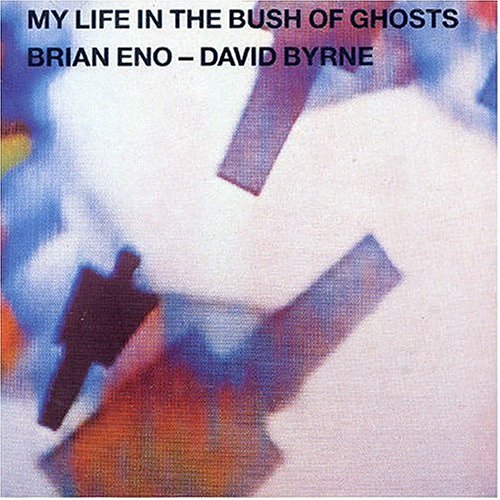
E is for Brian Eno/David Byrne: My Life In The Bush of Ghosts (EG, 1981)
Predictably, this semi-ambient album was a good 10-15 years ahead of its time, using found sounds, samples and beats. It's great.
F is for 'Fatal' Microbes: Violence Growns (Small Wonder, 1978)
This single is a classic of the late punk era, very post-Siouxie vocally and made (judging by the band photo, see below) by a bunch of High School kids, the title track is ambitious and a bit of a drag, but 'Beautiful Pictures' is just a great punk-pop song.
G is for Girlschool: Demolition (Bronze, 1980)
The 'female version of Motorhead' are at their most intense on this relentless NWOBHM album. Better, some (me) might say than Motorhead, although that might be controversial.
H is for Bo Hansson: Music Inspired By Lord of the Rings (Charisma, 1972)
In comparison with Howard Shore’s soundtracks to the Lord of the Rings movies, or indeed the epic
atmospheric black metal of Austria’s Summoning (2006’s Oath Bound being an especially strong and accessible example), Bo
Hansson’s LOTR album is kind of jazzy (sometimes inappropriately funky) and ineffectual.
On the other hand, on those terms it’s an enjoyable Mike Oldfield-ish time
capsule of its era.
I is for Iron Maiden:
Seventh Son of a Seventh Son (EMI, 1988)
At the time it seemed to many that Seventh Son was another example of Maiden losing their edge, but in
retrospect it was the last in a series of truly great albums and to this day
stands as one of their best. What is great is that they encapsulate all of
their ambitious, progressive tendencies, but in songs that are concise, catchy
and powerful.
J is for Jobriath: Creatures of the Street (Elektra, 1974)
Despite the fact that his eponymous 1973 album had
expensively flopped, Jobriath was given another chance with this peculiarity;
while it is still essentially glam rock, here he brought in the influence of
musicals and a kind of Cabaret-esque
Germanic decadence, plus pinches of folk, Rolling Stones influences and some
genuinely lovely heartfelt romanticism (such as opening track ‘Heartbeat’). Taken altogether it proved –
not surprisingly – to be hardly anyone’s cup of tea, and was to be his
swansong, which is a shame.
K is for Killing
Joke: Killing Joke (EG, 1980)
Legendarily grim industrial post-punk, what is less often
mentioned about this classic debut is that, like Joy Division (but even more
so), the band had an ear for a catchy pop tune, most notably ‘The Wait’ and ‘Wardance’, which may well be dark and brooding, but is also
accessible and of its time in an almost chart-worthy (indeed the latter
actually did chart in the US, slightly).
L is for Lionheart: Hot Tonight (Epic, 1984)
Ex-Iron Maiden guitarist Dennis Stratton’s Lionheart were in
theory a far more radio-friendly proposition than Maiden themselves; don’t
think they got much airplay though. With a glossier production this would sound
like a big American hair metal album. As it is, it’s an endearingly scruffy attempt
at US style anthemic rock by some less-than-glamorous Londoners.
M is for Milk ‘N
Cookies: Milk ‘N’ Cookies (Island, 1975)
Milk ‘N’ Cookies are a strangely British sounding New York band,
something akin to the teenybopper tail end of glam rock made by bands like
Hello, Bay City Rollers, Buster et al. Although not all great, it has a mix of
energy and cutesyness that makes it enjoyable in small doses.
N is for The Nutty
Squirrels: Uh-Oh! parts 1 & 2 (Pye, 1959)
Essentially a rip-off of The Chipmunks (whose first records
were made in 1958, though it would be a few years before they appeared in
cartoons), this single was far less successful, probably because where the
Chipmunks sang pop hits, the Nutty Squirrels played a far cooler (but guitar
based) kind of BeBop/Jazz, complete with (inevitably high pitched) shouts of ‘yeah
man!’ etc. It’s fun.
O is for October
Falls: The Streams of the End (Debemur Morti, 2006)
As nature-centric, tuneful, folk-influenced post-black
metal, Finland’s October Falls preceded (and then were absorbed into) the
current post-BM/shoegaze scene. This EP is as good a record of the band’s
beautiful yet bleak style as any; lovely and autumnal, even at its most
aggressive.
P is for Pilot: From The Album of the Same Name (EMI, 1974)
One of the few successful bands ever to have come from
Edinburgh, Pilot suffered a slight lack of credibility due to founders David
Paton and Billy Lyall’s connections to an early incarnation of The Bay City
Rollers, but in actuality they were good enough musicians to have graced
recordings by Kate Bush, The Alan Parsons Project etc, and their own music bore
little relation to the glam pop of the Rollers. This album, while essentially a
pop-rock record, is sometimes complex, jazzy, subtle and affecting and was the
first in a series of underrated albums long overdue for rediscovery.
Q is for Queen: Hot Space (EMI, 1982)
Far from a fan favourite, Hot Space nevertheless features some of Queen’s least
characteristic and most underrated songs, such as the disco-inflected ‘Dancer’ and Freddie Mercury’s tribute
to the then recently-deceased John Lennon, ‘Life
is Real’.
R is for David
Rhodes: Baroque Guitar and Lute (Titanic, 1975)
Just the nicest baroque guitar album I have heard; delicate,
lovely and with a wistful atmosphere that matches the Watteau picture on the
sleeve.
S is for The Staple
Singers: Will The Circle Be Unbroken
(Buddha, 1968?)
Not at all funky, this mainly gospel album instead features
beautiful singing (of course) and the atmospheric, shimmering, reverb-laden
guitar of Pops Staples.
T is for The Tigers: The Tigers Story Vol 1 (Polydor, 1970)
The Tigers may be one of the least credible of Japan’s ‘Group
Sounds’ bands, but this anthology shows that, like their Western counterparts
The Monkees, there was a lot of skill and inventiveness involved in the commercial,
bandwagon-jumping pop music they created.
U is for Uriah Heep: Very ‘Eavy, Very ‘Umble (Bronze, 1970)
Derided by the music press as Led Zeppelin clones, this
debut is nevertheless one of the greatest hard rock LPs of the 1970s, and
rarely bears more than the slightest resemblance to Led Zep and that probably
owes more to the band’s blues/hippy roots than to direct influence. If you like
70s hard rock listen to this album.
You may not like it, of course.
V is for The Vapors: New Clear Days (United Artists, 1980)
One of the albums
of the new wave era, it’s a shame that The Vapors are mainly known for the
near-novelty hit ‘Turning Japanese’.
Admittedly it is one of the standout tracks, but the whole is nevertheless a
good solid album.
W is for Stevie
Wonder: Journey Through The Secret Life
of Plants (Motown, 1979)
Okay, not one of his classics, but it is unthinkable that
Stevie Wonder in the 70s would release a double album with no good tracks; and
of course he didn’t. The soundtrack to a rarely seen documentary, this doesn’t
include any great soul-funk-pop singles, or even much in the way of vocals, but
it’s an often beautiful and evocative piece of work.
X is for X-Ray Spex: Germ Free Adolescents (EMI, 1978)
One of the truly iconic albums of the punk explosion, unlike
many contemporaries, X-Ray Spex were not scared to use elements (notably
saxophone) deemed uncool by the movement as a whole, and this album is rebellious
in its enthusiasm and playfulness as much as in its rejection of things like
pitch perfect singing and musicianliness.
Y is for Neil Young: Everybody Knows This Is Nowhere (Reprise, 1969)
A classic. Nice dog, too.
Z is for Frank Zappa:
Overnite Sensation (DiscReet, 1973)
This album marked a point where Zappa seemed to have tired
(temporarily) of the restless experimentation of the Mothers of Invention and
played something no less accomplished, but more dynamic, concise and
commercial. Although many find post-Mothers Zappa offensively puerile, that’s the point. And it’s good.